
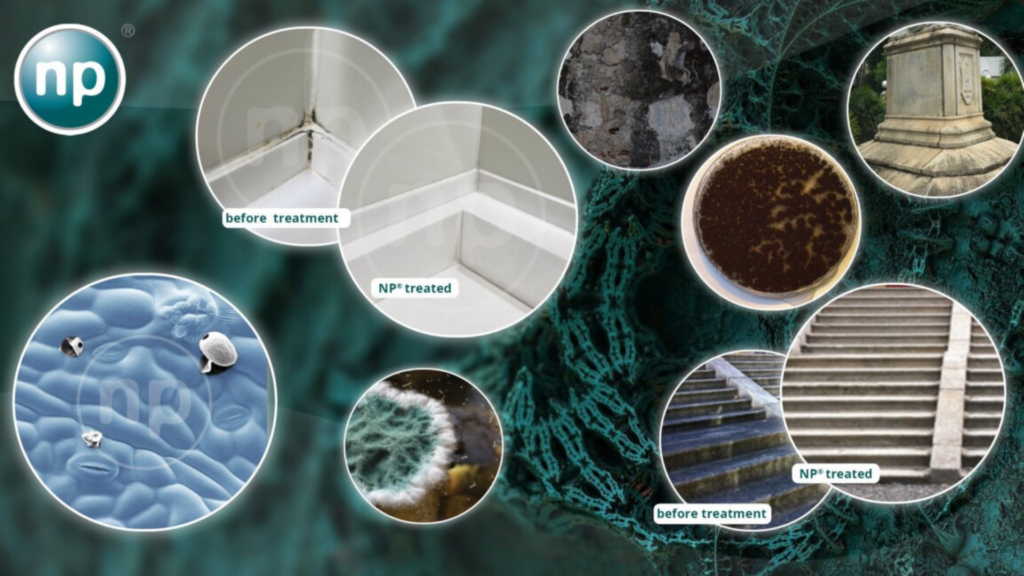
Whether outdoors or indoors – mould spores are present everywhere in our ambient air at all times. This is not a problem at first, as long as they do not settle on surfaces and multiply there uncontrollably. Yet that is exactly what happens faster than you might think, because mould is extremely undemanding. For the step from normal presence in the air to dangerous spread across a surface, all it takes is a sufficient degree of warmth, humidity and a few organic nutrients, which can be found almost everywhere. Nevertheless, the market offers hardly any prevention. Find out here why so-called Liquid Glass makes every surface permanently unattractive to mould spores.
The Inadequacy of Prevention and Eradication
It is quite astonishing that search engines respond to the query mould prevention primarily with mould removers or tips on indoor climate. Of course, correct ventilation and heating are extremely important for many reasons, but they cannot be implemented optimally in every situation. In rooms, seasons or regions with a warm, humid climate, this measure alone is often not enough.
Acting only once the health-endangering infestation has already taken hold cannot be a solution, especially since the mould filaments often spread invisibly deeper into the material than surface removal can reach. Many mould removers are, moreover, not exactly harmless to health themselves.
What is needed, then, is a prevention that is easy to apply anywhere and that gently keeps floating mould spores from settling on surfaces and multiplying. To understand why “Liquid Glass” fulfils exactly these requirements perfectly, let us first look at what mould actually does on different materials.
Disrupting the Mould Fungus in Its Living Habits
We know a great variety of mould fungi. Around 40 species of them can be harmful to human health. What they have in common is that they are all quite modest when it comes to the board and lodging of their chosen accommodation. Thanks to its complex metabolism, a mould fungus can utilise almost any organic nutrient.
Even on substrates that themselves offer no organic substances as food, the modest mould fungus finds what it needs. On glass surfaces, for example, it happily feeds on the dust that has settled there.
While removal succeeds relatively easily here, things become much more critical with other materials: on wooden surfaces, for example, the mould fungus can feed on parts of the colonised surface itself. On plastic surfaces or seals, on the other hand, it prefers to feed on organic additives such as plasticisers.
That the materials are permanently damaged in both cases is self-evident. However, this happens not only because of the mould’s food intake. In addition, the fungus’s excretions also attack the surface. Its entire metabolism thus causes destruction of the materials.
Effective mould prevention must therefore deny the spores access to the coveted micronutrients on the one hand, and protect the surfaces from the fungus’s secretions on the other. Various anti-mould coatings attempt this, but bring further problems with them:
Many of the products themselves contain concerning toxins that can harm people, animals and the environment. There is talk, for example, of allergenic or carcinogenic ingredients, of possible damage to eyes or airways. Due to the permanent release of an active substance, many anti-mould paints also lose their effect relatively quickly. In addition, they frequently alter the appearance, feel or breathability of a surface.
Long-Lasting Protective Barrier Without Side Effects
Instead of plastering over surfaces or countering mould infestation with concerning toxins, the Liquid Glass barrier from Nanopool intervenes in the mould fungus’s living habits in a gentle and environmentally friendly way:
The basis of the internationally proven NP® products is a high-performance raw material that forms an ultra-thin, elastic and breathable glass-like layer on materials of all kinds. Five hundred times thinner than a human hair, the functional barrier is imperceptible to the bare senses, but bonds firmly with the treated surface and equips it with repellent properties.
This counteracts possible mould infestation in three ways:
- Firstly, the spores can no longer access the nutrients of organic surfaces, as these remain out of the fungus’s reach beneath the barrier layer of just 5 to at most 100 nanometres.
- Secondly, dirt and dust particles do not adhere permanently to the superphobic coating, so this food source is also struck off the mould spores’ menu.
- Should the fungus nevertheless settle briefly – which is hardly possible due to the repellent properties of the Liquid Glass layer – the treated material is protected by the barrier from the fungus’s harmful excretions.
The NP® coating can be applied without protective equipment by simple spraying or wiping onto almost any absorbent or non-absorbent surface:
Whether wood, textiles, masonry, tiles, joints or seals – the functional barrier is effective indoors and outdoors for a long time, without releasing any substances into the environment.
NP® Liquid Glass thus represents a permanent method, completely harmless to health, of effectively preventing the settlement of the mould spores present everywhere in the ambient air – even in areas that are difficult to ventilate.
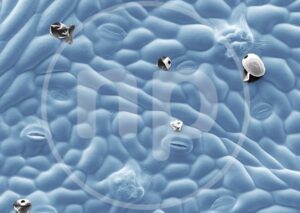
The original image of an organic surface, magnified many times with a scanning electron microscope (SEM), shows: treatment with NP® Liquid Glass denies the microorganisms on the surface access to their food source, so they cannot survive permanently.
For further questions about the many possible applications of the NP® protective coating, the company headquartered in Schwalbach/Germany will be happy to help: info@nanopool.eu
About the company:
nanopool® GmbH, based in Hülzweiler, is an innovative family business. Since 2002 it has been among the companies working with nanotechnology in the field of surface refinement.
nanopool® has succeeded in developing a surface refinement for almost all areas of application. This innovation will change working life positively in the most diverse directions.
All nanopool® products are based on the latest scientific findings of nanotechnological research. The mode of action of the environmentally award-winning, food-safe products has been confirmed by recognised experts.