
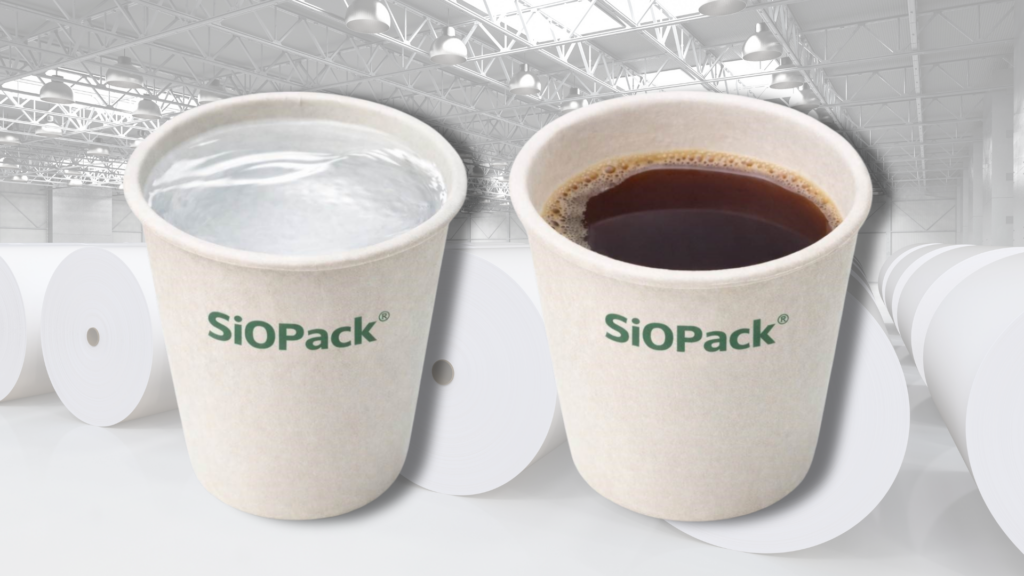
New barrier technology stabilizes dry-fiber geometries under humid process conditions and improves further processing in industrial filling lines.
By Dieter Schwindt, certified expert for nanotechnology and surface applications
Dry-fiber packaging is regarded as a promising approach to reducing plastic-based packaging solutions. In industrial practice, however, a central problem emerges: under humid process conditions, the materials quickly lose mechanical stability. This can lead to deformation, disruptions in machine handling and, in the worst case, downtime on filling lines.
This is particularly critical in applications with high humidity or direct contact with liquids, as is common in the food and beverage industry. Existing hydrophobization solutions often reach their limits here, as they either impair forming or are not optimally scalable in economic and process terms.
Challenges of dry fiber in humid process environments
Dry-fiber packaging is sensitive to increased humidity and direct contact with water. Even under moderate climatic conditions, a significant reduction in mechanical stability can occur.
On industrial filling lines – especially in areas with moisture ingress or direct contact with liquids – this problem is further amplified. Components can swell or lose their shape, which impairs machine handling. The consequences are disruptions on the filling line, increased reject rates and potential downtime.
In practice, such effects frequently lead to additional cleaning cycles and a restart of the production line – a clear economic disadvantage.
Limits of existing solutions
Conventional hydrophobization methods such as AKD can only be used to a limited extent with dry fiber. A key approach in dry-fiber processing is instead to leave the fibers unaffected during forming, so that processes such as stretching and drawing can be carried out completely and without restrictions.
The functional barrier is therefore deliberately applied only after forming. In many cases, an additional external coating is thus required.
Alternative approaches – such as the use of MFC for hydrophobization – are known, but are often associated with higher costs and reduced process speed. An industrially scalable solution with a stable barrier effect and, at the same time, good processability therefore remains a challenge.
SiOPack® as a solution approach
With SiOPack® technology, a coating system is available that enables a stable water barrier on fiber-based materials without affecting the forming process. The aim is to reduce moisture absorption while improving the mechanical stability of components during further processing.
The results to date show that significant improvements can be achieved through the use of suitable barriers:
- reduced moisture absorption
- improved dimensional stability of dry-fiber components
- more stable machine handling during further processing
- lower reject rates
- increased process reliability in filling lines
Test results under practical conditions
The results obtained in the course of testing show an improvement in storage and process stability. Storage times of more than 150 days could be achieved under non-climate-controlled conditions without significant losses in top-load stability.
The results indicate potential for future applications in the field of hot beverages as well as other moisture-sensitive packaging applications.
Assessment from industry practice
Packaging expert Stephan Halstrick of HALSTRICK Consulting Services – The Packaging Experts – has examined the SiOPack® barriers in his own tests and sees particular potential for improving the process stability of dry-fiber packaging:
“With dry fiber in particular, moisture can lead to a rapid loss of mechanical stability. The results show that suitable barriers – such as those provided by SiOPack® – can help to equip different dry-fiber geometries more robustly and improve further processing in humid filling environments.”
Presentation at interpack 2026
The results presented will be shown to a professional audience for the first time and discussed further at interpack 2026 in Düsseldorf. The focus is in particular on the stabilization of dry-fiber geometries under humid process conditions.