
Workwear, upholstery, vehicle interiors, hotels, healthcare: textile surfaces face moisture, stains and mechanical stress every day. The NP® Liquid Glass technology protects the fibres while feel and breathability remain unchanged.
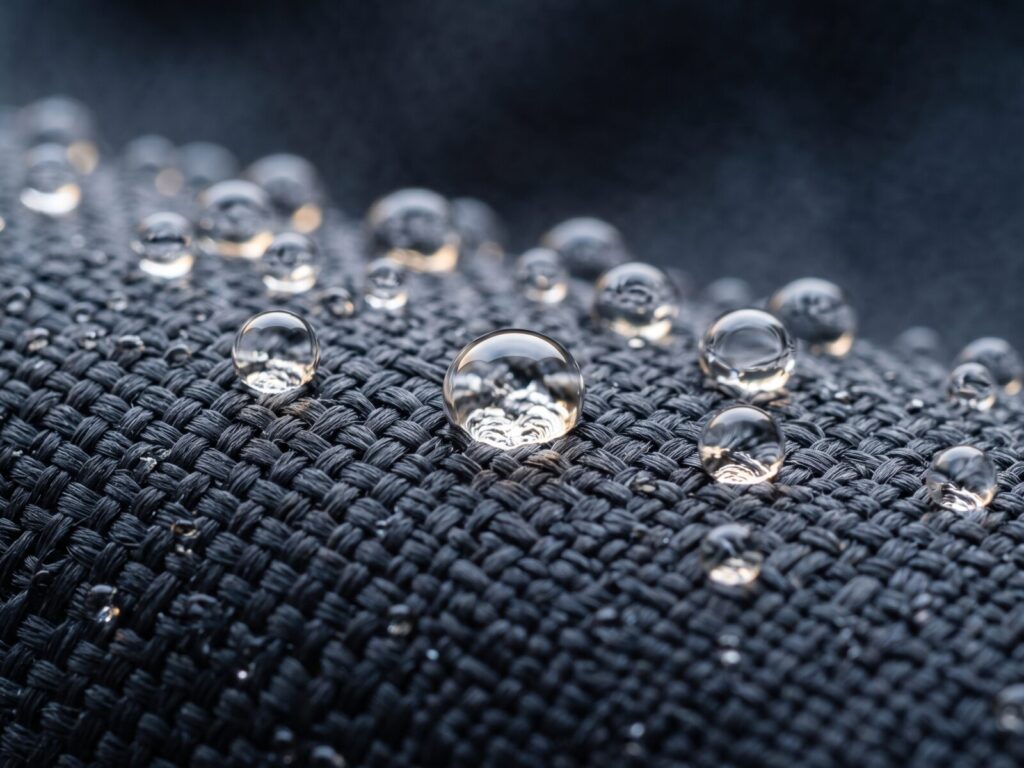
Liquids are repelled at the fibre surface.
Liquids and stains soak into the fibres.
The NP® Liquid Glass technology creates an ultra-thin, transparent protective layer on individual textile fibres. Through targeted functionalisation of the fibre surfaces, water- and dirt-repellent properties are achieved without significantly altering the natural flexibility, breathability, or feel of the material.
The appearance, touch, and wearing comfort remain unchanged. The surface function is created at the nanoscale level: the characteristic properties of the textiles are maintained while cleaning is facilitated and care requirements simplified.
The performance of the NP® Liquid Glass technology has been tested by independent research institutes and accredited testing laboratories: water- and dirt-repellent properties, resistance to abrasion, washing cycles and artificial weathering, as well as material compatibility, PFC-free formulation, OEKO-TEX® conformity and ZDHC MRSL compliance.
The results demonstrate that the NP® Liquid Glass technology maintains its protective function even under demanding operating conditions, without negatively affecting the tested material properties or the fire behaviour of textiles.
The nanopool surface technologies are suitable for a wide range of natural and synthetic textiles. Tap a material for details:
Especially with high-quality textiles, maintaining the original material properties is essential. Research confirms that the NP® protective layer acts directly on the fibre surface while preserving flexibility, feel, and the character of the material. Tap an application area for typical use cases:
Professional clothing in demanding daily use.
Workwear and textiles in healthcare and care facilities face liquids, contamination and constant laundering. The repellent fibre function supports hygiene and durability.
Textiles that stay presentable through heavy use.
Bed linen, table linen and furnishing fabrics stay presentable longer, with reduced washing effort and preserved comfort.
Upholstered surfaces protected against spills and stains.
Everyday spills bead off upholstery fabrics instead of soaking in; cleaning is easier and the fabric character stays.
Interior textiles in cars, rail and aviation.
Seat covers and interior textiles resist stains and daily wear, supporting a well-maintained interior over years of use.
Companies, facility operators, and textile service providers face the challenge of using high-quality textiles economically, hygienically, and sustainably. nanopool solutions create added value through:
Designed for:
The most common questions about protecting textiles and textile surfaces.
No. The transparent NP® protective layer has been developed to preserve the natural feel, flexibility, and appearance of the material.
Yes. Since the coating only creates a nanoscale surface function, the characteristic properties of the textiles remain largely unchanged.
Yes. The protective performance has been tested against repeated washing cycles. A durable stain-repellent effect has been demonstrated even after up to 50 washing cycles.
Yes. Independent tests confirm that the NP® Liquid Glass technology is PFC-free. Compliance with OEKO-TEX® ECO PASSPORT and ZDHC MRSL requirements has also been verified.
Yes. By protecting high-quality textiles, extending service life, and reducing cleaning and maintenance requirements, the technology can contribute to sustainable utilisation concepts.
Tell us about your textile application. We advise manufacturers, operators and textile services on the right protection concept for high-quality textiles.