
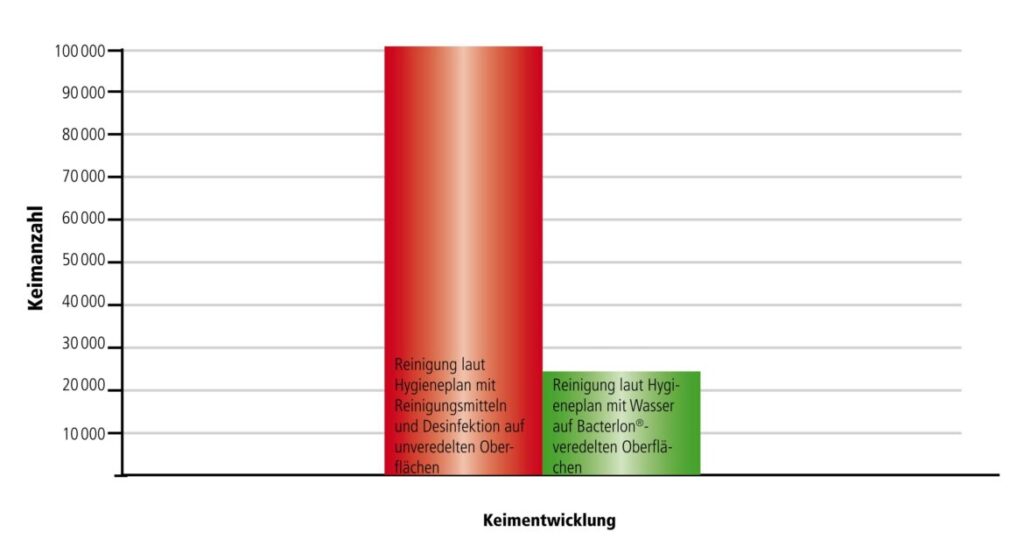
Nalbach. The Saarland-based company nanopool has developed a process for “refining” germ-prone surfaces in care homes for the elderly with an ultra-thin glass film. Vulnerable people in particular could thus be better protected against contagious diseases. The results of a microbiological study at the AWO senior residence Primsmühle in Nalbach give cause for hope: the number of pathogens on surfaces previously treated with the nanopool product “Bacterlon®” – such as floors, furniture, door handles, light switches and handrails – was reduced significantly, in some cases by up to 95 percent.
“Infections are of particular importance in care homes for the elderly,” said Saskia Schwindt of nanopool at the presentation of the study. Communal living always poses a risk of germ and infection transmission. “For a healthy person, this is usually not a problem. For older or weaker people, however, it can pose a risk of illness.” In addition, the number of persistent germs such as MRSA continues to rise. The norovirus, which repeatedly strikes care homes in autumn and winter, is also a danger. The tiny viruses can survive for up to six weeks on door handles, upholstery and other surfaces. “That is why it is very important to prevent the spread of bacteria while they are still in the colonization phase, so that they cannot multiply.”
This insight prompted the AWO regional association of Saarland to take an innovative step. Encouraged by the initiative of Saarland’s Health Minister Georg Weisweiler to combat the MRSA pathogen, the association agreed to launch a trial together with nanopool at the senior residence in Nalbach. “We wanted to see whether it was possible to further improve our hygiene measures with the help of nanopool,” said Paul Quirin, chairman of AWO Saarland.
In the spring, numerous surfaces in the senior residence were coated with “Bacterlon®” by certified nano-technicians. Initial so-called contact plate tests were encouraging: the germ load on the treated surfaces had dropped by almost half, even though the cleaning staff – as specified by nanopool – used only warm water for cleaning. The next step was to obtain conclusive certainty. For twelve weeks, from the beginning of September to the beginning of December, everything was systematically checked at regular intervals and the samples were analyzed in the laboratory, under the professional supervision of independent microbiologists.
“The results of the study have confirmed our expectations,” says a delighted Saskia Schwindt. After all, nanopool can also draw on this experience elsewhere. The innovative product of the Schwalbach-based company, which operates throughout Europe, is used, for example, in hospitals in England as well as in the SHG clinics.
For AWO administrative director Wolfgang Hermann, the advantages are obvious. “The residents of the senior residence stay healthy longer and consequently need to go to hospital less often.” And several percent could be saved on the cost of cleaning agents.
AWO is now considering using the Bacterlon® technology in other of its senior care homes as well.
About the company:
Nanopool® GmbH, headquartered in Hülzweiler, is an innovative family-owned company.
Since 2001, it has been among the companies working with nanotechnology in the field of surface refinement.
Nanopool® has succeeded in developing a surface refinement solution for almost every field of application. This innovation will positively change working life in a wide variety of ways.
All Nanopool® products are based on the latest scientific findings from nanotechnology research. The effectiveness of the environmentally friendly, food-safe products has been tested by recognized research laboratories and confirmed by certificates.
Web: www.nanopool.eu